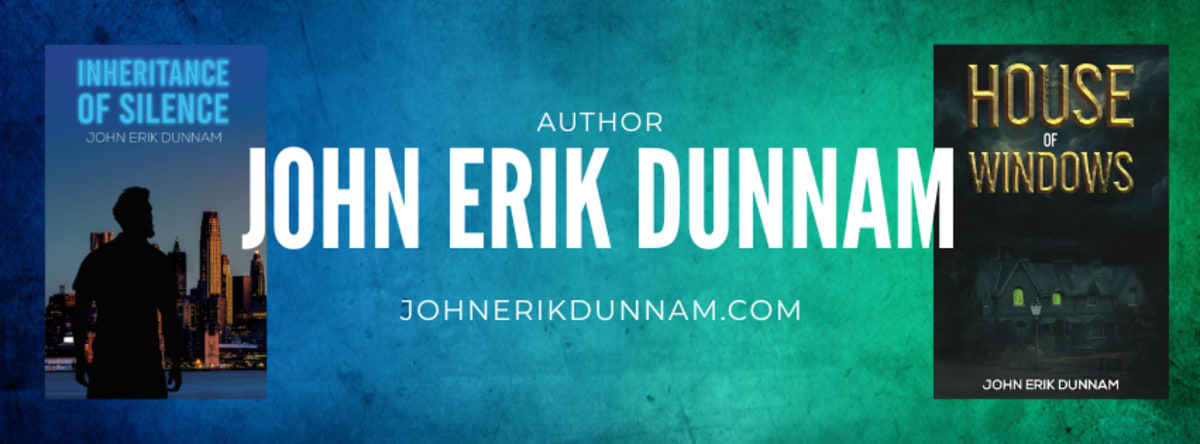
From Inheritance of Silence to House of Windows: The Road Between Two Novels
When Inheritance of Silence was published in April 2026, I thought I understood what it meant to become a published author.
Then I wrote House of Windows.
Five months separated the publication of my first novel from the release of my second. On paper, that isn't much time. In reality, the road between Inheritance of Silence and House of Windows changed the way I think about writing, publishing, storytelling, and the kind of author I want to become.
These are two very different novels.
But they came from the same writer.
And somewhere along the road between them, I began to understand my voice.
Where It Began: Inheritance of Silence
Inheritance of Silence was my introduction to readers as novelist John Erik Dunnam.
At its heart, the novel explores relationships, identity, vulnerability, resilience, and the things people carry with them long after the original moment has passed. It asks what happens when the past refuses to remain neatly contained in the past—and what it costs to finally confront the things we have spent years avoiding.
I knew those themes mattered to me when I wrote the book.
What I could not have anticipated was what would happen after it entered the world.
Readers began responding to the emotional honesty of the story. Recognition followed. Inheritance of Silence became a winner of the Shakespeare Global Prize for Contemporary Fiction and Best Independent Press Title, and it received additional recognition through literary competitions and awards.
Those moments were meaningful, certainly.
But something more important was happening beneath them.
I was learning what connected readers to my work.
It wasn't perfection.
It wasn't spectacle.
It was humanity.
The uncomfortable parts. The contradictions. The relationships that don't fit neatly into boxes. The things people desperately want to say and somehow cannot.
And, perhaps most importantly, the lives we present to everyone else versus the lives we actually live.
That realization became one of the bridges to House of Windows.
Then Came House of Windows
House of Windows was published on September 11, 2026.
Writing a second novel presents an interesting challenge.
With the first book, there is no established expectation. You are introducing yourself.
With the second, there is suddenly a question:
Who are you as a writer?
I didn't want to write Inheritance of Silence again.
I wanted House of Windows to demonstrate that the emotional core readers found in my first novel could exist inside an entirely different story.
The setting could change.
The characters could change.
The circumstances could change.
The world itself could change.
But the fascination with human beings—their secrets, desires, relationships, identities, contradictions, fears, and extraordinary capacity for survival—could remain.
That became the thread.
The Space Between What We Show and What We Hide
If there is one idea connecting Inheritance of Silence and House of Windows, it may be this:
People are rarely only what they allow us to see.
We build versions of ourselves for different rooms.
There is the person our coworkers know.
The person our family knows.
The person our friends know.
The person our partners know.
And then there is the person standing alone when nobody else is watching.
Both Inheritance of Silence and House of Windows are interested in that space.
They explore identity, relationships, LGBTQ+ experiences, emotional vulnerability, resilience, and the complicated distance between appearance and reality.
That doesn't mean the novels tell the same story.
They don't.
Instead, they ask related questions from different directions.
What do we inherit?
What do we hide?
What happens when the carefully constructed version of our lives begins to crack?
And who are we when the windows finally become transparent?
Becoming John Erik Dunnam, the Author
There is another story connecting these books that isn't written on either one's pages.
Mine.
Publishing Inheritance of Silence forced me to learn that writing a novel and building an author career are two completely different endeavors.
Writing happens largely in private.
Being an author happens very publicly.
Suddenly there were book launches, reader conversations, interviews, websites, media, events, awards, marketing decisions, publishing conversations, reviews, social media, and an ever-growing collection of manuscripts waiting behind the books already released.
The transition was fast.
Sometimes exhilarating.
Sometimes frustrating.
Frequently educational.
But through all of it, something became increasingly clear:
I wasn't interested in building my identity around a single book.
I wanted to build a body of work.
Inheritance of Silence was never supposed to be the finish line.
It was the beginning.
Two Books Are Different From One
There is something psychologically significant about seeing a second published novel sitting beside the first.
One book says:
I wrote a book.
Two books begin to say:
I am building a catalogue.
That distinction matters to me.
Inheritance of Silence introduced readers to my work.
House of Windows expands what that work can be.
And the manuscripts that follow will expand it further.
Some will be serious.
Some will be funny.
Some will be unsettling.
Some will be deeply personal.
Some may look completely unlike anything that came before them.
But I don't believe an author has to spend an entire career telling one story simply because readers responded to it.
I would rather spend mine exploring why people become who they become.
Writing LGBTQ+ Characters as People First
LGBTQ+ identity is an important part of my fiction, but I've never wanted identity to become a substitute for characterization.
People are complicated.
Queer people are complicated.
We can be heroic and selfish, hilarious and infuriating, confident and terrified, successful and spectacularly messy—sometimes before lunch.
That complexity interests me.
Representation matters because people deserve to see themselves in literature.
But representation becomes particularly powerful when characters are allowed to possess the same contradictions, flaws, ambitions, desires, failures, ridiculous decisions, and emotional depth afforded to everyone else.
I want readers to recognize pieces of themselves in these characters even when their lives look nothing alike.
Because underneath genre, identity, geography, sexuality, background, and circumstance, human beings tend to wrestle with remarkably similar questions.
Am I loved?
Do I belong?
What am I hiding?
What am I afraid of losing?
Can I become someone different from the person my past created?
Those questions live throughout my work.
What Inheritance of Silence Taught Me
My first novel taught me that publication doesn't complete a story.
Readers do.
Every person brings a different history to a book. A scene that feels secondary to one reader can become the defining moment for another.
That changed how I approached storytelling.
I became more conscious of emotional architecture—not simply what happens in a story, but why it matters.
A plot can make someone turn a page.
Emotion makes them remember why they turned it.
That lesson traveled with me into House of Windows.
What House of Windows Taught Me
My second novel taught me something different.
Expansion requires risk.
Once something works, there is an enormous temptation to reproduce it.
But I don't want my catalogue to become variations of the same book wearing different jackets.
House of Windows gave me permission to expand.
To experiment.
To take the emotional DNA that mattered to me and place it inside a different structure.
That freedom has influenced everything I have written since.
The Beginning of Something Larger
When I look at Inheritance of Silence and House of Windows today, I don't see two isolated novels.
I see the first two markers along a much longer road.
There are more stories coming.
More characters.
More experiments.
More unexpected turns.
And probably more than a few moments when I wonder what on Earth I have gotten myself into.
But that is part of becoming an author.
You don't discover your voice once.
You discover it again every time you challenge it.
Inheritance of Silence gave me a beginning.
House of Windows gave me expansion.
What comes next will be another evolution entirely.
And that may be the part of this journey I love most.
The road isn't finished.
We're barely out of the driveway.
About John Erik Dunnam
John Erik Dunnam is an American author whose fiction explores identity, relationships, resilience, vulnerability, LGBTQ+ experiences, and the complicated realities people often hide beneath carefully constructed lives. His published novels include Inheritance of Silence and House of Windows, with additional works currently in development.
Readers can explore John Erik Dunnam's books, author news, awards and nominations, events, media coverage, and upcoming projects at JohnErikDunnam.com.